Mike Milo and Donna Clements’ marriage
Cry MachoMike Milo and Donna’s marriage survives emotionally after it has failed as a shared life: each still loves the other, but neither wants to live together. Their meetings are marked by carefulness, pity, and practical kindness rather than anger. The separation becomes most visible in the contrast between their quiet farewell and Mike’s grief soon afterward, when he goes to Laurie’s grave and accuses his dead child of causing his pain.
A marriage recognized as over
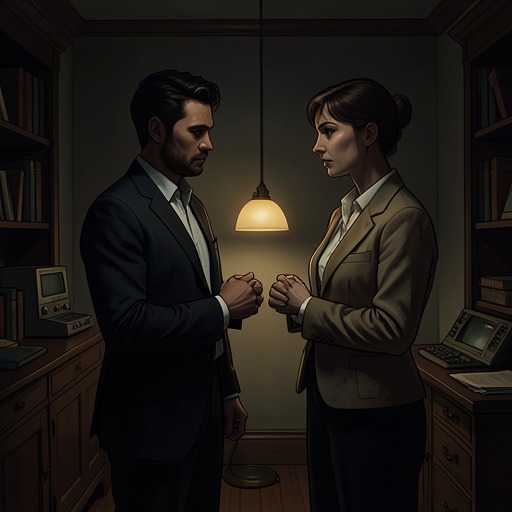
When Mike considers his former wife, he finds that even describing her is difficult. He can recall her appearance—slender, with long legs and dark eyes against her blonde face—but knows that this physical inventory does not capture her. At their meeting, Donna seems unusually neat and composed, sitting with her knees and ankles together and speaking in clean, separate words. That manner tempts him to see her as cold, but he corrects the impression: she is ordinarily warm, genuinely smiling, and open-handed toward people in pain. His portrait holds two versions of her at once, the woman he sees in this strained encounter and the caring person he knows beyond it.
The same complexity governs his thoughts about their marriage. Mike wonders whether he would have married Donna if he had understood how different she was from what she had seemed, or whether he would still have fallen in love with her. The questions have no practical answer; what matters is that he still loves her, and believes she still loves him. Yet love does not undo the condition he calls incurable: they no longer want to live together. Even brief meetings have become increasingly painful, and the pain is not expressed as reproach. What passes between them is something more grievous, a mutual pity that registers affection without suggesting reconciliation.
Careful words and an intimate farewell
Their conversation is constrained even when Donna shares news that prompts Mike to wish her happiness. He tells her, “I’m sure you’ll be happy, Donna. This time,” then immediately adds that he hopes she will be. The qualification escapes before he can stop it; his correction softens the remark but cannot make the exchange easy. They fall silent again. The narration stresses how little they have to say, even in the presence of important news, and how distressingly careful they are with each other. Their unspoken strain feels like tight bandages: an image of pressure and restraint, not open hostility.
As Mike prepares to leave, he notices a photograph of Laurie that he had not seen before. He does not recognize the little girl at first, then understands who she is and feels the recognition as a pang. His remark that he had never seen the picture brings his grief into a meeting already burdened by their separation. When he jokes that he is always losing things, the line reveals more than he intended. Donna catches its self-revelation and gently touches his arm, telling him to try not to be so alone. Her gesture is both intimate and limited: she can recognize his loneliness and offer comfort, but their former marriage cannot make that loneliness hers to resolve.
Mike cannot bear her commiseration and regrets having cast a shadow over her good fortune. He pats her cheek gently and says, “If I don’t see you—be happy, Don.” Donna answers, “You too . . . please,” and he replies, “Sure.” The exchange is affectionate without pretending that they are returning to life as spouses. His use of her familiar shortened name and the touch on her cheek preserve closeness; the conditional farewell, and the pause within it, acknowledge that they may not meet again. Their tenderness makes the distance more painful rather than closing it.
The separation and its aftermath
The decisive departure comes later, after Mike learns that Rachel has married her high-school sweetheart. The morning he hears the news, when any action on his part would already be too late, he leaves Donna. Neither is angry. Donna helps him pack, reminds him that two sport jackets are still at the cleaners, insists he take books she knows he cherishes, and reserves a room at the hotel where he will stay temporarily. Even the damaged suitcase he is tying with rope belongs to the practical scene of departure: she attends to the ordinary details of his leaving instead of turning it into a quarrel.
At the car, Donna kisses him gently—not as a husband, but as a son going off to the army. The comparison recasts their parting as an act of care that has outlasted the marital role. It does not mean their bond has been slight; the narration says they had not ached for each other so much in a long time. Their separation thus produces a paradox: only in leaving does Mike feel again the full force of what remains between them. The tenderness of the packing and kiss neither reverses his decision nor disguises its cost.
Toward evening Mike is drunk in the rain at Laurie’s grave, pounding the wet earth with his feet and yelling, “It’s your fault!” The accusation is directed at his dead child, not at Donna, and the scene should not be mistaken for an explanation of the marriage’s end. Instead, it places the separation beside a grief that has its own force and history. The sequence makes clear that Mike’s departure does not free him from loss: he leaves a relationship still marked by love, then gives voice to anguish that cannot be answered. Donna and Mike part without blame, but their care for one another cannot protect either from the loneliness and mourning that remain.